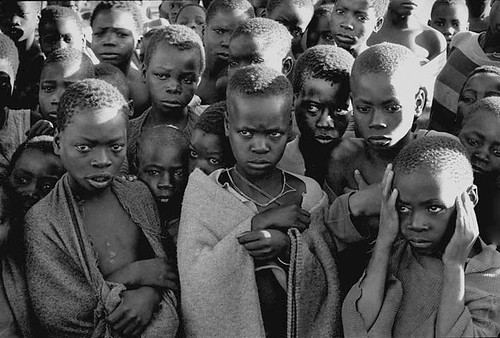
Recently, a friend posed a simple question: What is your definition of poverty? Of course, there were a few people who responded predictably with the help of Merriam and Webster. Others responded in a more philosophical tone, largely defining the word in terms of "spiritual poverty", with reference to the absence of or alienation from God. One man even formulated an equation: physical needs = spiritual needs. He hoped to move our humanitarian efforts toward "sacred" ones. Hmmm. After considering the definitions and responses, I considered my own. And, I have concluded that on the issue of poverty, predictable trumps philosophical.
I think if we spiritualize the meaning of poverty, it qualifies the "we/they" collective as “poor”. And, the truth is, “we” are not living in poverty. I may feel like a poor grad student, but I am not poor. You, reading this post on a computer - in English - are not poor. Some of the “they”, though, are indeed poor. And, to spiritualize poverty brings an inward focus to something that is, in reality, quite the opposite. People in poverty are living without their basic needs to survive: food, water, shelter, etc. God, doesn’t just want us to take care of spiritual needs, He calls on us to care for daily, tangible needs. Jesus commands us to feed the hungry, give water to the thirsty, care for the sick, weak, poor, orphaned, widowed. And, if we spiritualize poverty, it diminishes our obligation to care for the basic needs of others. It makes us just as “needy” as those living without the basic essentials for life and it thwarts us from our role, our responsibility, of being contributors, benefactors, advocates for those living in poverty.
I wholeheartedly believe that God is our Sustainer and is All that we need. Still, God created us with physical needs here on earth. And, the Bible documents these needs again and again. God provided food for Elijah, manna for His people, and water from a rock. Jesus & the disciples fed followers. Jesus told the mother of a boy he raised from the dead to give the boy something to eat as soon as he was raised. Clearly, physical needs are important to God. I think they parallel spiritual needs, noting that God frequently takes care of peoples' physical needs before their spiritual ones.
I don't think that when James defines true religion as "look[ing] after orphans & widows", he chooses this demographic because they are in poverty spiritually. On the contrary, we know they are blessed: "The last shall be first." But, they have other needs as well. Addressing physical poverty, then, must be a primary, if not "sacred", goal of Christians. Thus, when we formulate our own equation for our role in alleviating poverty, we must not be get lured into the negligent belief that physical needs = spiritual needs. Let us instead be accountable to an alternate, and often more challenging, one:
humanitarian acts = spiritual, sacred acts
Let us figure out ways to prove this equation. I hope that as we preach The One who offers us water that allows us to never thirst again, we do not forget this is a metaphor. And, we remember that there are, in fact, over a billion people who lack access to clean drinking water in this world.
Here is a good website for more info and statistics on physical poverty: ttp://www.globalissues.org/article/26/poverty-facts-and-stats


 Posts
Posts


No comments:
Post a Comment